
Social story topics
Social story: Taking turns
Taking turns has rules nobody writes down: how long a turn lasts, who goes next, what to do with your hands while you wait. For many autistic and neurodivergent students the waiting feels endless and the rules feel arbitrary, and the result looks like grabbing or quitting when it is really confusion.
This story makes the rules visible: how we know whose turn it is, what the student can do while waiting, and how the turn comes back. Read it before a game session and use a visible turn marker, such as a token passed from player to player, so the rule can be seen as well as heard.
A sample story
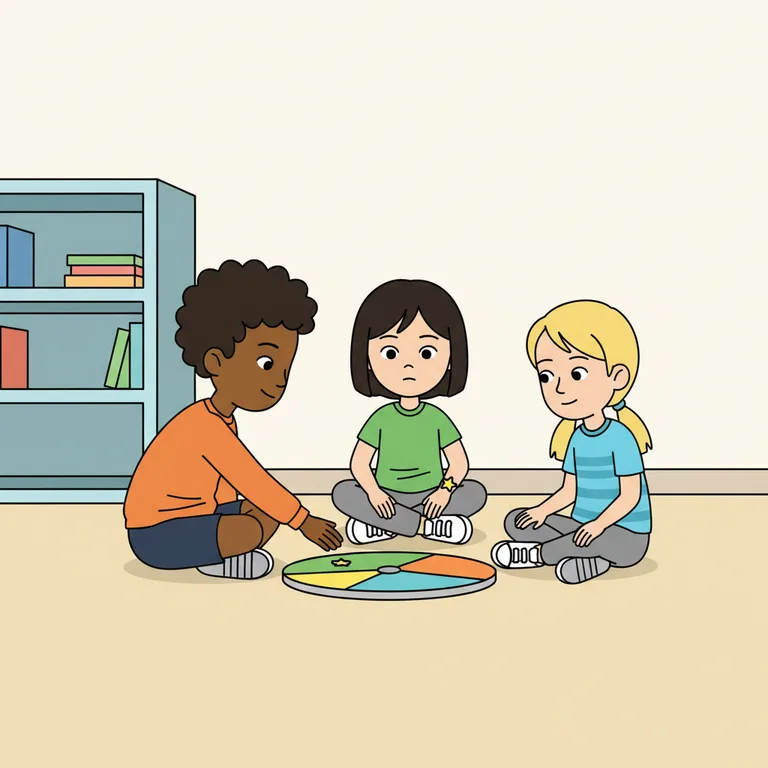
Taking Turns in a Game
- 1First, we each wait for our turn in the game.
- 2My friends wait because waiting means everyone gets a go.
- 3Then I pick up the spinner and press it down with one finger.
- 4Finally, I take my turn and feel happy playing with my friends.
A sample made with HandsOnTop. Yours is written for your student.
Make this story for your student
The situation is filled in. Add a name and what they love, then click Make it — the first one is free.
Free to try · no card needed.
Tips for using it
- Use a turn token that moves from player to player.
- Start with two-player games and short turns before trying a group.
- Say what the waiting player can do, not only that they must wait.
Common questions
Can one story cover turns in class as well as games?
Keep it to one setting per story. The game version is usually the place to start because the stakes are low and the practice is fun.
What is a turn token?
Any object, a bean bag or a card, that the player whose turn it is holds. It makes the abstract rule into something you can see and pass.
How does this story end?
With the turn coming back and the game being fun for everyone, in the student’s own words if you edit it. A hopeful last page matters.